
Scalable DevOps Solutions: In today’s rapidly evolving digital landscape, businesses must deliver not only fast software but also reliable and secure systems. However, many organizations still focus only on speed, which often leads to instability and poor user experience. As a result, companies face increased risks of customer churn and performance issues.
Therefore, the need for devops services for businesses has become more critical than ever. Instead of treating speed as the only goal, organizations now prioritize both performance and reliability. Moreover, by integrating Quality Assurance (QA) with DevOps processes, teams can ensure continuous testing and faster feedback.
Consequently, this approach creates a strong feedback loop that improves software quality at every stage. In addition, automated testing within DevOps pipelines enhances efficiency and reduces deployment risks. Ultimately, scalable DevOps solutions help businesses achieve both agility and long-term stability.
The Evolution of Modern Software Quality
Historically, QA was treated as a distinct “checkpoint” at the very end of a project timeline. Developers would build the app, throw it over the wall to the testers, and then cross their fingers that no critical bugs were found. In a modern ecosystem running on scalable devops solutions, that isolated structure is dead. Quality is no longer a separate phase; it is an ongoing responsibility baked directly into the code from the very first commit.
Continuous Integration and Delivery: The QA Guardrail
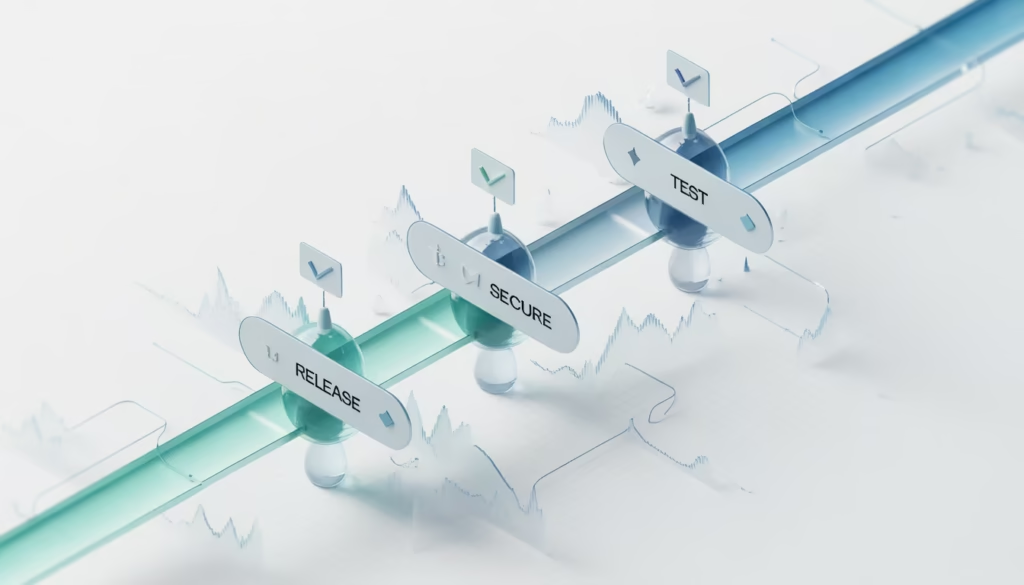
At the center of a reliable tech stack sits the practice of continuous integration and delivery (CI/CD). This framework ensures that any new code generated by a team is immediately tested and validated before moving toward production.
Real-Time Validation
When a developer pushes an update, the CI system doesn’t just check to see if the code compiles. It launches a battery of tests to check for security vulnerabilities, logic flaws, and performance drops. This shift-left testing strategy allows teams to discover breaking issues when they are small and easy to fix, rather than after they are in the hands of the end user.
Guarded Deployments
The ultimate value of continuous delivery is peace of mind. By automating the gating process, organizations ensure that human error cannot accidentally push broken software to live servers. If a test fails, the deployment halts automatically, safeguarding business continuity.
| Feature | Traditional QA Testing | DevOps-Driven QA |
| Test Execution | Manual or scheduled batches | Triggered automatically on every commit |
| Bug Discovery | Late in the lifecycle | Early in the development cycle |
| System Visibility | Fragmented reports | Continuous dashboards and real-time monitoring |
| Scalability | Blocked by manual labor | Infinite, using scalable devops solutions |
| Ownership | Dedicated QA team only | Shared responsibility across Dev, QA, and Ops |
The Power of Software Testing and Automation
To achieve true scale, manual regression testing must be eliminated. Software testing and automation act as the digital immune system of your application.
Types of Automated Tests to Implement
To get the most out of your infrastructure, focus on automating these critical tiers:
- Unit Tests: Validating the smallest parts of the application isolated from the rest.
- Integration Tests: Ensuring different microservices or databases talk to each other correctly.
- Performance & Load Tests: Simulating thousands of concurrent users to ensure your cloud resources scale appropriately.
By removing the human bottleneck in these repetitive tasks, companies can redeploy their human QA talent to focus on exploratory testing and complex edge-case scenarios that automated scripts might miss.
Building Scalable DevOps Solutions for the Future
The defining trait of elite engineering teams is the capability to scale resources automatically when demand spikes.
Infrastructure as Code (IaC) with Automated Testing
True scalability in DevOps means treating server configurations the same way you treat application code. When you use tools like Terraform or Ansible to build your environments, those environment files should go through the exact same continuous integration and delivery pipeline. This guarantees that your testing environment is a perfect replica of your production server, removing the dreaded “it worked on my machine” problem.

For business owners wondering how to design these heavy systems without bloating their internal tech budgets, looking at strategic IT professional services can bridge the gap. Delegating your pipeline management to a specialized squad ensures high uptime without massive overhead.
Deep Dive Resources
To push your tech stack to its full potential, consider exploring these specialized paths:
- Our Impact: See high-uptime architectures we’ve built in our Project Portfolio.
- Built-In QA: Learn how we handle automated testing in App Development.
- AI Enhancement: Discover how AI can find bug patterns via our Custom AI Development services.
- External Insights: Review the latest standards on the NIST Software Development Framework or consult the AWS Well-Architected Framework.
Frequently Asked Questions (FAQs)
1. What are the best devops services for businesses to start with?
Most organizations get the fastest ROI by focusing on continuous integration and automated regression testing first. Fixing the pipeline before scaling infrastructure prevents you from just automating the delivery of broken code.
2. How does continuous integration and delivery help the QA team?
Instead of spending days manually clicking through a website to make sure old features didn’t break, automation handles regression checks. This allows the QA team to do valuable creative hacking, accessibility testing, and UX audits.
3. Does software testing and automation slow down the deployment process?
Initially, running a massive suite of tests might take a few minutes. However, by running tests in parallel in the cloud and prioritizing critical pathways, elite DevOps teams can execute thousands of tests and complete a deploy in under ten minutes.
4. What makes a devops solution truly scalable?
A truly scalable solution uses containers (like Docker) and automated orchestrators (like Kubernetes). This allows the software to measure incoming web traffic and automatically spin up more server power to match the load, spinning back down to save money when traffic leaves.
5. How much code coverage is needed in automated testing?
While 100% code coverage is a common goal, chasing that number often results in writing useless tests. Focus on covering 70-80% of your application, making sure that your core revenue-generating pathways (like the checkout button or login portal) are covered heavily.
Ready to stop compromising on software stability?
Contact Techticks Today for a comprehensive tech stack audit. We specialize in building automated pipelines and devops services for businesses that need software to perform perfectly at scale.
If you have any questions regarding “DevOps & QA Integration”, feel free to contact us. For inquiries, call us at: +1 (983) 212-4713.
Disclaimer: The above information is subject to change and represents the views of the author. It is shared for educational purposes only. Readers are advised to use their own judgment and seek specific professional advice before making any decisions. TechTicks is not liable for any actions taken by readers based on the information shared in this article. You may consult with us before using this information for any purpose.